How Many Calories Should You Eat Per Day?
Your daily calorie needs depend on your age, sex, size, activity, and goal. Here is a plain-language guide to figuring out exactly how many calories you should eat — and how to use that number.
If you have ever tried to lose weight, build muscle, or simply eat a little better, you have probably asked yourself: how many calories should I eat per day? It is one of the most common nutrition questions — and for good reason. Your calorie intake is the single biggest lever you have over changes in your body weight.
The honest answer is that there is no one-size-fits-all number. The calories you need depend on your age, sex, height, weight, activity level, and goal. But that does not mean you have to guess. With a basic understanding of how your body uses energy and a reliable calorie calculator, you can land on a personalised target in under a minute.
This guide breaks down everything that affects your daily calorie needs, gives you average ranges to orient yourself, and explains how to adjust your intake for losing, maintaining, or gaining weight.
How Many Calories Should You Eat a Day?
As a rough starting point, most adults need somewhere between 1,600 and 3,000 calories per day. Women tend to fall toward the lower end of that range and men toward the higher end, but activity level moves the number far more than sex alone. A sedentary woman may maintain her weight on 1,600 calories, while an active man who trains hard can easily need 3,000 or more.
These averages are useful for context, but they are not a prescription. Your actual number could sit well above or below them. The only reliable way to find it is to estimate your Total Daily Energy Expenditure (TDEE) and then adjust for your goal — which is exactly what a calorie calculator does for you.
Calculate Your Daily Calorie Needs
Rather than memorising formulas, the fastest way to find your number is to use a calculator built on an evidence-based equation. The Fitlydoo Calorie Calculator uses the Mifflin-St Jeor equation — widely considered the most accurate formula for the general population — and applies an activity multiplier and goal adjustment automatically.
Enter your age, sex, height, weight, activity level, and goal to get your personalised daily calorie target in seconds.
Once you have your number, the rest of this guide will help you understand where it came from and how to use it.
Average Daily Calorie Needs for Adults
The U.S. Dietary Guidelines publish estimated calorie needs by age, sex, and activity level. The table below summarises the ranges for adults. Use it as a sanity check against your calculator result — not as a replacement for it.
| Group | Sedentary | Moderately Active | Active |
|---|---|---|---|
| Women (19–30) | 1,800–2,000 | 2,000–2,200 | 2,400 |
| Women (31–50) | 1,800 | 2,000 | 2,200 |
| Women (51+) | 1,600 | 1,800 | 2,000–2,200 |
| Men (19–30) | 2,400–2,600 | 2,600–2,800 | 3,000 |
| Men (31–50) | 2,200–2,400 | 2,400–2,600 | 2,800–3,000 |
| Men (51+) | 2,000–2,200 | 2,200–2,400 | 2,400–2,800 |
Estimated daily calorie needs for adults (U.S. Dietary Guidelines)
What Determines How Many Calories You Need?
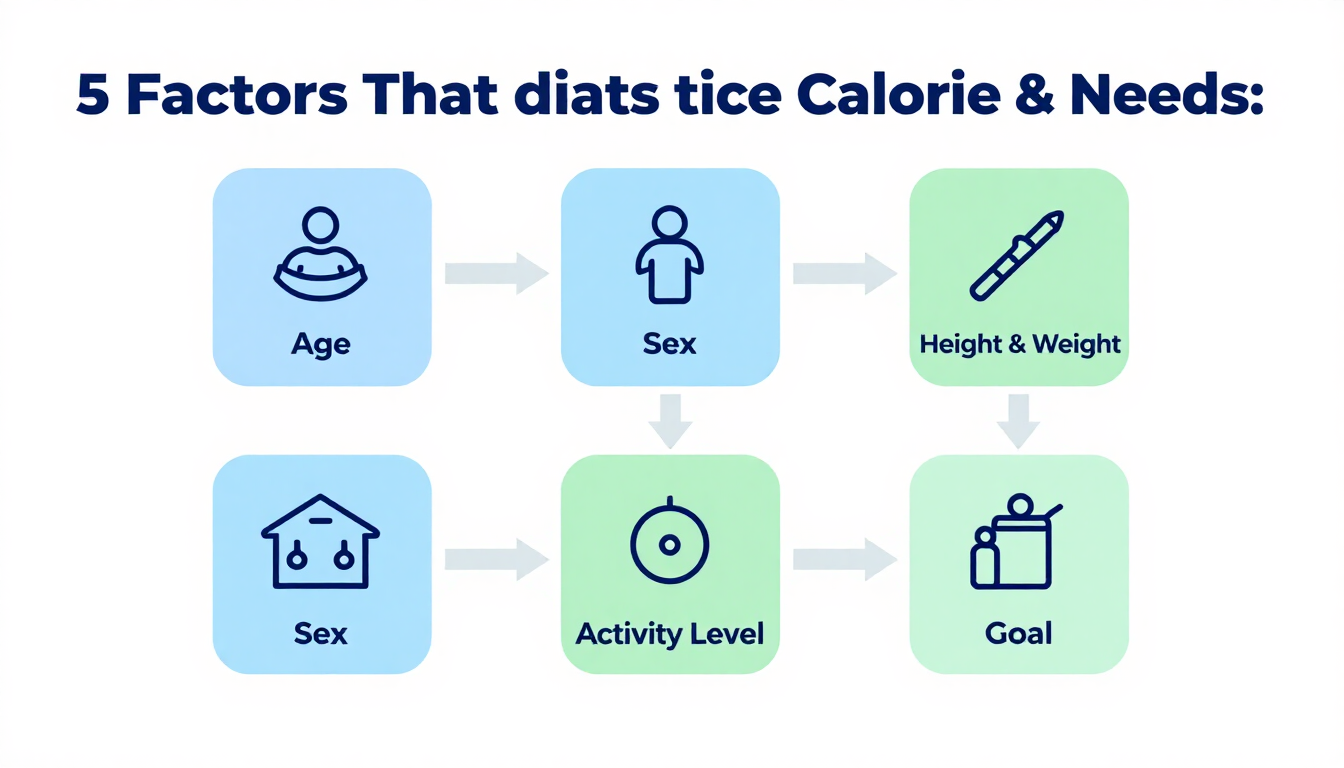
Your calorie needs are not random — they are the product of a handful of measurable factors. Understanding each one helps you see why your number is unique and why it changes over time.
Age
Metabolism naturally slows as you get older, mostly because of a gradual loss of muscle mass (sarcopenia) and hormonal shifts. After about age 30, basal metabolic rate declines by roughly 1–2% per decade. That means a 50-year-old typically needs fewer calories than a 25-year-old of the same size and activity level. Staying active and doing resistance training can slow this decline considerably.
Sex
On average, men need more calories than women because they tend to carry more lean muscle mass, which burns more energy even at rest. The Mifflin-St Jeor equation accounts for this directly with separate formulas for men and women. That said, an active woman can easily need more calories than a sedentary man — activity matters more than sex.
Height and Weight
A bigger body requires more energy to maintain. Both height and weight feed into your BMR calculation. Importantly, lean mass (muscle) is more metabolically active than fat tissue, so two people who weigh the same can have different calorie needs depending on their body composition.
Activity Level
This is the single most variable factor. A sedentary person might multiply their BMR by 1.2, while someone who trains intensely six days a week could multiply it by 1.7–1.9. That difference can swing your daily total by a thousand calories or more. Be honest with yourself about how active you really are — overestimating is the most common reason people fail to lose weight.
Goal
Finally, your goal determines whether you eat at, below, or above your maintenance calories. To lose weight you eat less than you burn; to maintain you eat roughly equal; to gain weight you eat more. The size of that gap controls how fast the change happens.
What Is a Calorie?
A calorie is simply a unit of energy. In nutrition, the calories listed on food labels are actually kilocalories (kcal) — the amount of energy needed to raise the temperature of one kilogram of water by one degree Celsius. When we say a food contains 200 calories, we mean it provides 200 kcal of energy your body can use.
Your body needs that energy for everything: breathing, pumping blood, repairing cells, digesting food, and moving your muscles. If you eat more energy than you use, the surplus is stored (mostly as body fat). If you eat less, your body draws on its stored energy to make up the difference.
What Is BMR?
Your Basal Metabolic Rate (BMR) is the number of calories your body burns just to stay alive at complete rest — keeping your heart beating, lungs breathing, brain thinking, and cells repairing. It is the energy you would use if you stayed in bed all day and did absolutely nothing.
BMR typically accounts for about 60–70% of the calories you burn each day, which makes it the foundation of your total energy needs. Because it is driven largely by your lean body mass, age, and sex, two people can have very different BMRs even at the same body weight.
You can find your own BMR with the BMR Calculator, which uses the same Mifflin-St Jeor equation that powers the calorie tools on this site.
BMR vs. TDEE
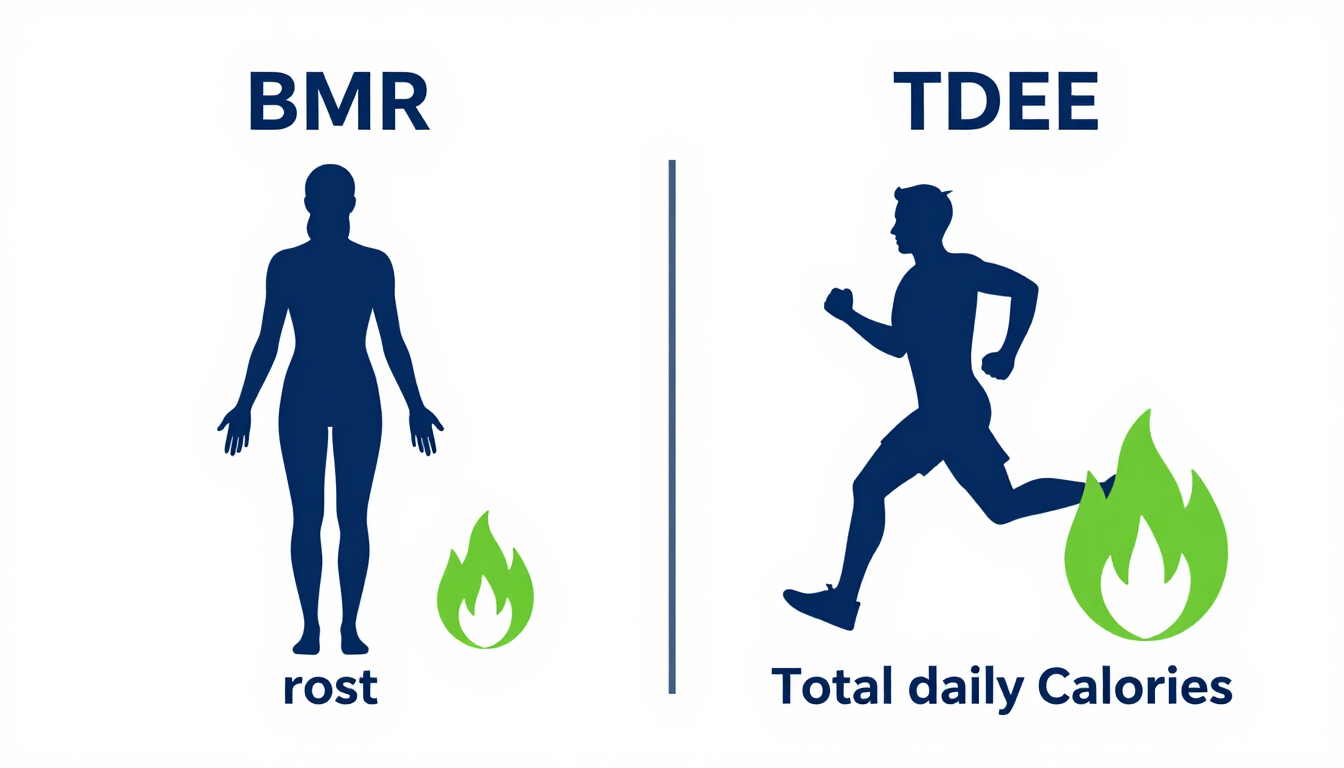
BMR and TDEE are easy to confuse, but the distinction matters. BMR is energy at rest. TDEE (Total Daily Energy Expenditure) is BMR plus everything else you burn — daily movement, exercise, and the thermic effect of digesting your food.
In other words, TDEE is the number you actually want when setting a calorie target, because it reflects your real daily life. The TDEE Calculator works this out for you by applying an activity multiplier to your BMR.
The key relationship
Maintenance calories = TDEE. Eat your TDEE and your weight stays roughly stable. Eat below it to lose weight, above it to gain.
How Many Calories Should You Eat to Lose Weight?
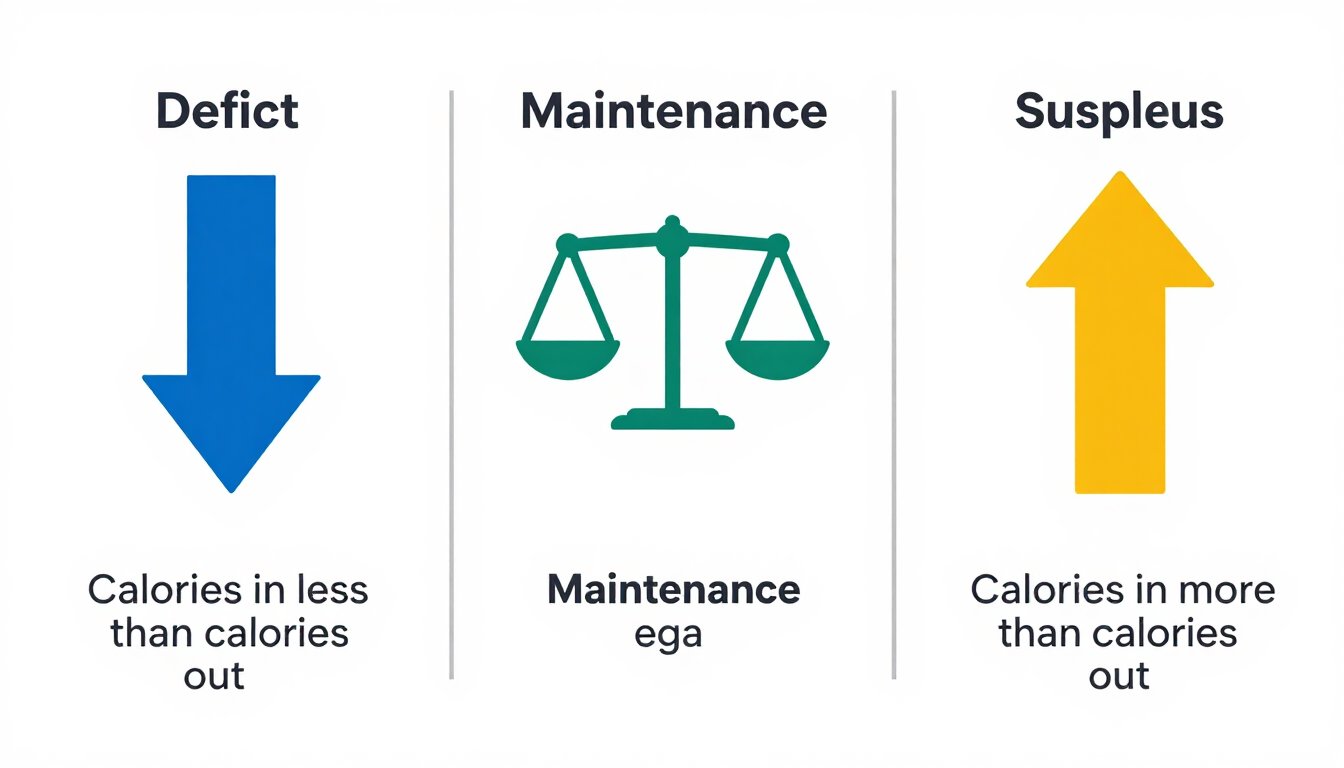
To lose weight, you need a calorie deficit — you consume fewer calories than your body burns, so it draws on stored energy (body fat) to cover the shortfall. A deficit of about 500 calories per day is the classic recommendation, which tends to produce roughly 0.5 kg (about 1 lb) of weight loss per week for many people.
A moderate deficit of 300–500 calories is generally the sweet spot. It is large enough to produce visible progress but small enough to preserve muscle, keep your energy up, and avoid the metabolic slowdown that comes with aggressive dieting. Most adults should not drop below about 1,200 calories per day (women) or 1,500 (men) without medical supervision.
Start with your calculator result
Use the Calorie Calculator to find your TDEE, then subtract 500 for a steady fat-loss target. Track your weight for two to three weeks and adjust based on real progress.
Don't Rely on the "3,500 Calories Equals One Pound" Rule
You have probably heard that cutting 3,500 calories from your weekly intake will lose you one pound of fat. This rule dates back to the 1950s and is still everywhere — but modern research shows it is an oversimplification.
As you lose weight, your body needs fewer calories, so the same deficit produces slower loss over time. Your metabolism also adapts slightly to restriction. The 3,500 rule ignores these dynamics and tends to overestimate how much weight people will lose. A better approach is to pick a starting deficit, track your results for a few weeks, and recalibrate. Weight loss is rarely linear, and that is completely normal.
How Many Calories Should You Eat to Maintain Your Weight?
Maintenance is simple in principle: eat roughly the number of calories you burn each day. In practice, that means eating at your TDEE. Your weight will fluctuate naturally by a kilogram or two from water, sodium, and glycogen, but the trend over weeks should stay flat.
If you are not trying to change your weight, the TDEE Calculator gives you your maintenance number directly. Use it as your daily anchor and adjust up or down by 100–200 calories if the trend drifts over a few weeks.
How Many Calories Should You Eat to Gain Weight?
Gaining weight — specifically muscle — requires a calorie surplus. You eat more than you burn so your body has the extra energy and building blocks to create new tissue. A modest surplus of 200–500 calories above your TDEE, combined with resistance training and enough protein, supports lean muscle growth without excessive fat gain.
Protein is the other half of the equation. Aim for roughly 1.6–2.2 grams of protein per kilogram of bodyweight to give your muscles what they need to repair and grow. The Protein Calculator works out your personal target, and the Macro Calculator can split your surplus calories into the right balance of protein, carbs, and fat so you gain mostly muscle rather than fat.
Bigger is not better
A huge surplus does not build muscle faster — it just adds fat. Even under ideal conditions, most people can gain only about 0.5–2 kg of muscle per month. Patience wins.
Calories Aren't the Whole Story
Calories determine whether your weight goes up, down, or stays the same. But they do not tell you everything about your health or body composition. Where those calories come from matters.
Protein and fibre keep you full and help preserve muscle. Highly processed foods, by contrast, are easy to overeat because they are calorie-dense and less satiating. Sleep, stress, and hormones also influence how your body uses and stores energy. A diet built mostly around whole, minimally processed foods makes hitting your calorie target far easier — because you feel full and energised rather than deprived.
How Do You Know If You're Eating the Right Number of Calories?
A calculator gives you a smart starting estimate, but the real proof is in your results. Track your body weight a few times a week (morning, after using the bathroom) and look at the weekly average, since daily fluctuations are noisy.
- If your goal is fat loss and the average is dropping about 0.25–0.5 kg per week, your deficit is working. Keep going.
- If the scale has not moved for two to three weeks, your estimate may be off — usually because activity was overestimated or intake underestimated. Trim 100–200 calories and reassess.
- If you are losing faster than 1% of your body weight per week, you may be losing muscle too. Eat a little more.
- For maintenance, a stable weekly average over a month confirms your number.
How you feel matters too. Persistent hunger, low energy, poor sleep, or declining gym performance are signs your intake is too low, even if the math says otherwise.
Should You Count Calories?
Counting calories is a tool, not a requirement. For many people — especially when starting out — tracking for a few weeks builds invaluable awareness of how many calories are actually in the foods they eat. Research consistently shows that people who track their intake are more likely to reach their goals.
But it is not the only path. Some people thrive with intuitive eating, portion-control habits, or simply prioritising whole foods and protein. If calorie counting feels stressful or obsessive, step back and use a lighter-touch approach. The best method is the one you can sustain for the long run.
How Many Calories Should You Eat at Each Meal?
There is no rule that says you must split your calories evenly across meals. What matters most is your total daily intake. That said, a rough framework helps with planning. If you eat three meals a day, divide your daily target into breakfast, lunch, and dinner — for example, 25%, 35%, and 40%, or roughly equal thirds.
Many people find that a larger dinner and lighter breakfast suits their appetite and social life, while others prefer a bigger breakfast. Protein distribution does matter somewhat: spreading protein across three to four meals (roughly 0.4 g per kg of bodyweight per meal) supports muscle protein synthesis better than front- or back-loading it. But the total still comes first.
What About Snacks?
Snacks are simply part of your daily total — they are not a separate category of calories. If you snack, account for those calories within your target. The main risk with snacking is that it is easy to forget: a handful of nuts, a latte, and a piece of cheese can quietly add 400+ calories.
If you prefer to snack, choose foods that are high in protein or fibre and pay attention to portions. If you do better on three solid meals with nothing in between, that works too. Match the pattern to your appetite and lifestyle.
Frequently Asked Questions
Start by calculating your TDEE, then subtract about 500 calories for a steady fat-loss target of roughly 0.5 kg per week. A deficit of 300–500 calories is sustainable for most people. Avoid dropping below 1,200 (women) or 1,500 (men) without medical supervision.
Your maintenance calories equal your TDEE — the total energy you burn each day including activity. Eat that amount and your weight should stay roughly stable over time, allowing for normal daily fluctuations.
For most adults, 1,200 calories is too low to meet nutritional needs and sustain energy, and it can slow your metabolism and cause muscle loss. It should only be used under medical supervision. A moderate deficit from your TDEE is safer and more sustainable.
On average, yes — men typically need more because they carry more muscle mass. But activity level and body size matter more than sex. An active woman can need more calories than a sedentary man of the same age.
Calculators using the Mifflin-St Jeor equation are accurate within about 10% for most people. They give a reliable starting point, but individual variation means you should adjust based on real-world results over two to four weeks.
Not necessarily. Tracking for a few weeks builds awareness, but it is not required long-term. If counting feels stressful, focus on whole foods, protein, and portion habits instead. The best approach is the one you can sustain.
Consistently eating too little can cause muscle loss, a slower metabolism, hormone disruption, nutrient deficiencies, and fatigue. A moderate deficit is safer and usually produces better long-term results than aggressive restriction.
For weight change, total calories matter most. For body composition, performance, and health, the balance of protein, carbs, and fat becomes important too. Start with calories, then refine your macros.
Eat in a small surplus of 200–500 calories above your TDEE, with 1.6–2.2 g of protein per kg of bodyweight and consistent resistance training. Larger surpluses add mostly fat, not extra muscle.
Metabolism slows with age — roughly 1–2% per decade after 30 — mainly due to loss of muscle mass and hormonal shifts. Staying active and doing resistance training can slow this decline significantly.
Calculate Your Daily Calorie Needs
You now know what drives your calorie needs and how to adjust them for any goal. The fastest way to turn that knowledge into a number is to use the Fitlydoo Calorie Calculator — it handles the math and gives you a personalised target in seconds.
Free, no sign-up, and based on the Mifflin-St Jeor equation.
A Note About Calorie Calculators
Informational, not medical advice
Fitlydoo calculators provide estimates for general wellness guidance only. They are not a substitute for professional medical advice, diagnosis, or treatment. Always consult a qualified healthcare provider before making significant changes to your diet, especially if you have a health condition.
Sources
- 1.National Institute of Diabetes and Digestive and Kidney Diseases (NIDDK). Health Tips for Adults
- 2.U.S. Dietary Guidelines for Americans. Estimated Calorie Needs
- 3.NIDDK. Eating & Physical Activity to Lose or Maintain Weight
- 4.NIDDK. Body Weight Planner
- 5.National Institute on Aging. How Much Should I Eat?
Related Articles
Understanding Your BMR (Metabolism)
What is my BMR, and what does it really say about your metabolism? This plain-language guide explains Basal Metabolic Rate, how to calculate BMR, the crucial BMR vs TDEE difference, why your BMR might seem low, and how to raise it — with free calculators to find your own numbers.
Read article NutritionHow Much Protein Do You Need Per Day?
Your daily protein needs depend on your weight, activity level, and goal — not a single universal number. Here is a plain-language guide to how much protein you really need per day, with examples, food tables, and a calculator to find your own target.
Read article MetabolismUnderstanding Your BMR: The Science Behind Your Metabolism
Your Basal Metabolic Rate is the number of calories your body burns just to stay alive. This guide explains what BMR is, the Mifflin-St Jeor equation behind it, how it differs from TDEE, what affects it, and whether you can actually change your metabolism.
Read article