How Much Protein Do You Need Per Day?
Your daily protein needs depend on your weight, activity level, and goal — not a single universal number. Here is a plain-language guide to how much protein you really need per day, with examples, food tables, and a calculator to find your own target.
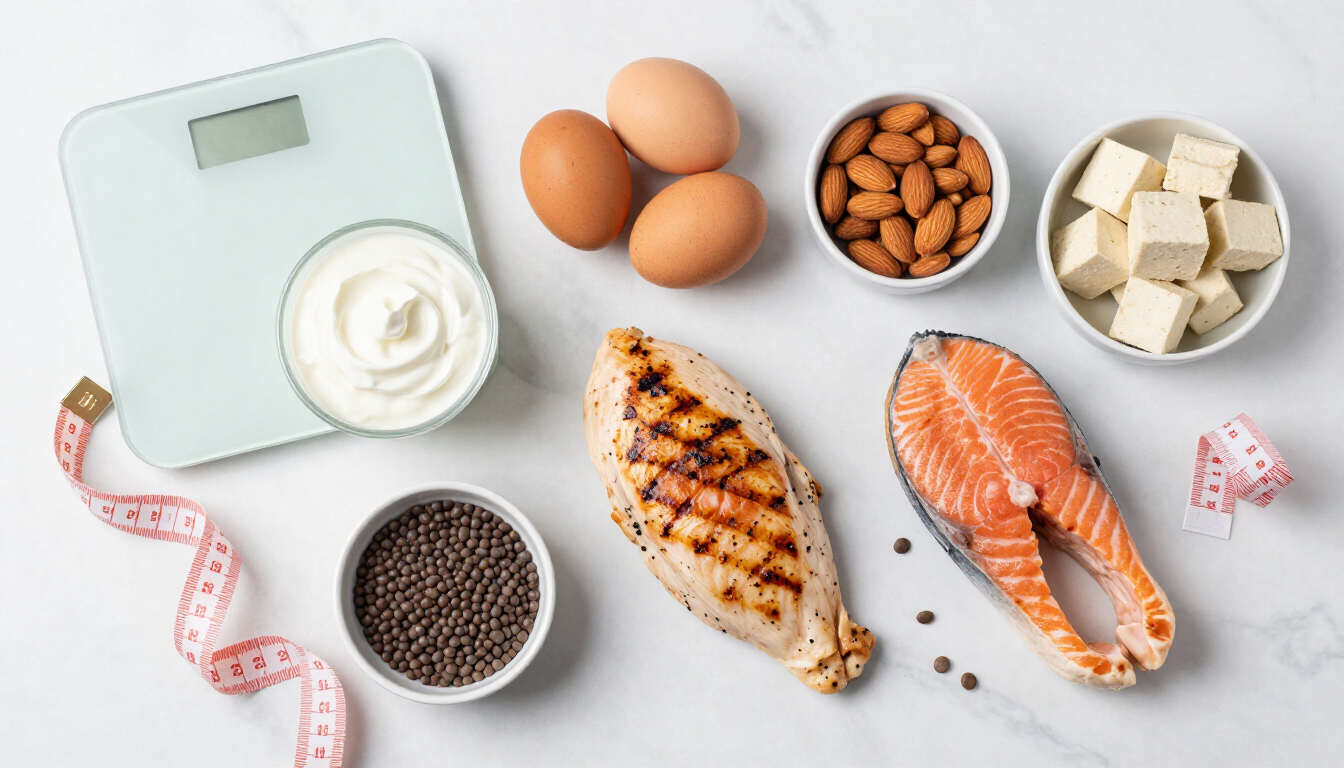
If you have ever wondered how much protein you need per day, you are not alone. It is one of the most searched nutrition questions on the internet — and the answers you find online are all over the map. Some sources say 50 grams is enough; others tell you to eat 200. So who is right?
The official starting point is the Recommended Dietary Allowance (RDA) set by the National Academies: 0.8 grams of protein per kilogram of body weight per day for the average sedentary adult. For a 70 kg (154 lb) person, that works out to about 56 grams per day. That number is the minimum needed to prevent deficiency — but it is not necessarily optimal, especially if you are active, trying to lose weight, or working to build muscle.
This guide breaks down how much protein you need per day based on your weight, activity, and goal, gives you real-world examples and food tables, and shows you how to calculate a target that is right for you.
How Much Protein Do You Need Per Day?
There is no single number that fits everyone. Your daily protein needs depend on three main things: your body weight, how active you are, and what you are trying to achieve (maintain, build muscle, or lose weight). As a general framework:
- Sedentary adults: 0.8 g per kg of body weight (the RDA) — the minimum to avoid deficiency.
- Active adults and recreational exercisers: 1.2–1.6 g per kg.
- People building muscle or training hard: 1.6–2.2 g per kg.
- People losing weight while preserving muscle: 1.2–1.6 g per kg (sometimes higher when in a large calorie deficit).
- Older adults (65+): 1.0–1.2 g per kg to counter age-related muscle loss.
Notice that the recommendations are given per kilogram of body weight, not as a fixed gram count. A 50 kg person and a 100 kg person clearly need different amounts. The per-weight approach is the most accurate way to think about it.
A Simple Example
Take two adults who both weigh 180 lb (about 82 kg). They weigh the same, but their protein needs are very different because their goals differ.
- Person A is sedentary and just wants to stay healthy. At 0.8 g/kg, they need about 66 grams of protein per day.
- Person B lifts weights four times a week and wants to build muscle. At 1.8 g/kg, they need about 148 grams per day — more than double.
Same body weight, very different targets. This is exactly why a one-size-fits-all gram recommendation does not work, and why calculating your own number based on your goal is the better approach.
What Does Protein Do in Your Body?
Protein is one of the three macronutrients (alongside carbohydrates and fat), and it does far more than build muscle. When you eat protein, your body breaks it down into amino acids — the building blocks it uses for countless jobs:
- Building and repairing muscle, skin, hair, nails, and other tissues.
- Producing enzymes that drive nearly every chemical reaction in your body.
- Making hormones that regulate metabolism, growth, and appetite.
- Supporting your immune system through antibodies.
- Transporting molecules (like oxygen-carrying hemoglobin) around the body.
Unlike carbohydrate and fat, your body does not store protein for later use. That is why you need a steady intake each day — if you do not eat enough, your body will break down existing tissue (including muscle) to get the amino acids it needs.
How Much Protein Do You Need Based on Your Weight?
The RDA of 0.8 grams per kilogram is the baseline used on nutrition labels and in public health guidance. The table below shows what that looks like across a range of body weights, so you can see the minimum at a glance.
| Body Weight | Body Weight (kg) | Protein at 0.8 g/kg |
|---|---|---|
| 100 lb | 45 kg | 36 g |
| 120 lb | 54 kg | 43 g |
| 140 lb | 64 kg | 51 g |
| 160 lb | 73 kg | 58 g |
| 180 lb | 82 kg | 66 g |
| 200 lb | 91 kg | 73 g |
| 220 lb | 100 kg | 80 g |
| 240 lb | 109 kg | 87 g |
Minimum daily protein at the RDA of 0.8 g per kg of body weight
This is the minimum, not the optimum
The 0.8 g/kg figure is enough to prevent deficiency in a sedentary person. If you exercise, want to change your body composition, or are over 65, you will likely benefit from more — often 1.2 to 2.2 g/kg depending on your goal.
How Much Protein Do You Need to Build Muscle?
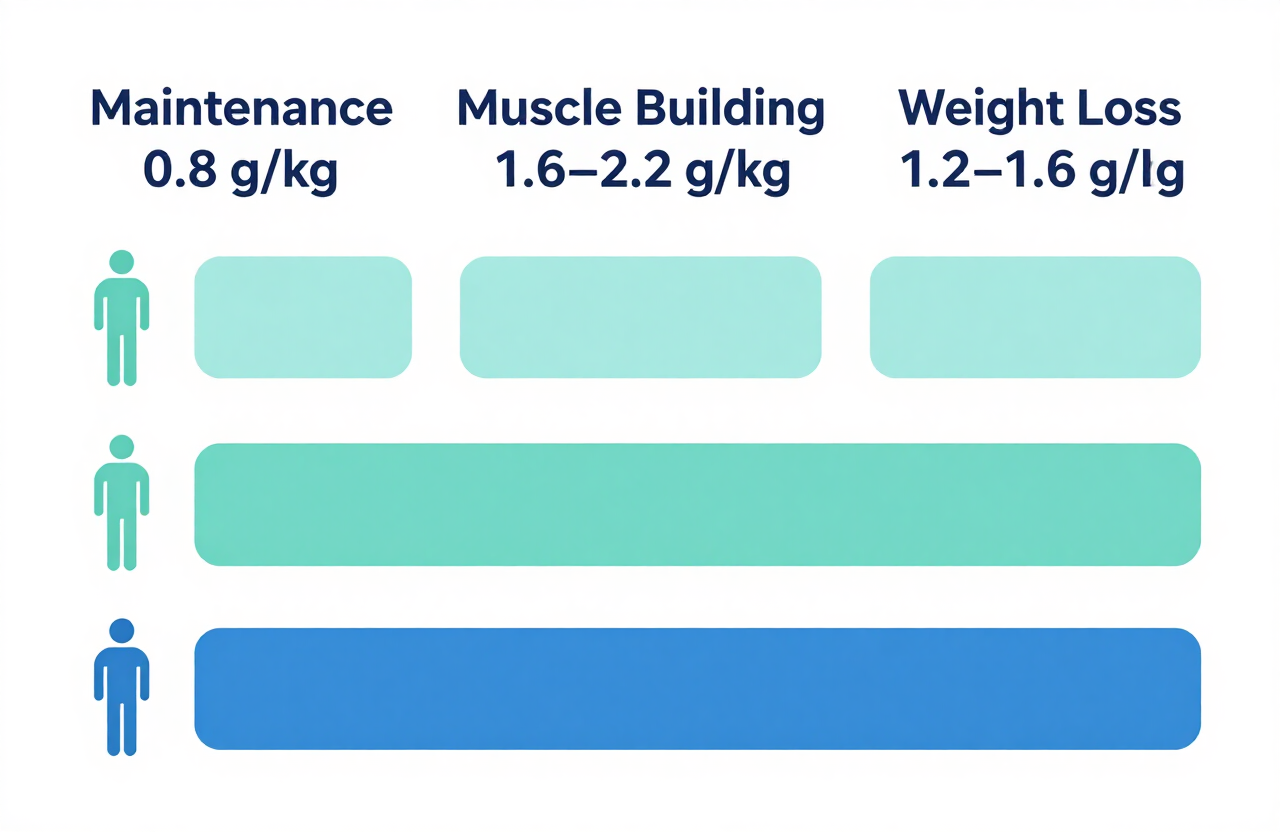
If your goal is to build muscle, protein needs go up. Resistance training creates tiny tears in your muscle fibres, and your body uses dietary protein to repair and build them back stronger. Research consistently shows that 1.6 to 2.2 grams of protein per kilogram of body weight per day supports muscle growth when combined with strength training.
Going above 2.2 g/kg does not appear to build extra muscle for most people — there is a ceiling effect. The bigger lever for muscle gain is a small calorie surplus and progressive overload in your training, not endlessly more protein.
To find your personal muscle-building target in seconds, use the Protein Calculator — it factors in your weight, activity level, and goal.
How Much Protein Do You Need to Lose Weight?
Protein is especially important when you are trying to lose weight, and not just because of the number on the scale. When you eat in a calorie deficit, your body can break down muscle as well as fat. Eating enough protein helps preserve lean muscle so that most of the weight you lose comes from fat.
For weight loss, aim for roughly 1.2 to 1.6 grams of protein per kilogram of body weight per day. If you are in a large deficit or already quite lean, going toward the higher end (even up to 2.0 g/kg) can help protect muscle and keep you full.
Start by working out your calorie target with the Calorie Calculator, then set your protein with the Protein Calculator. The Macro Calculator ties it all together by splitting your daily calories into protein, carbs, and fat so you lose fat while keeping muscle.
Does Eating More Protein Help You Feel Full?
Yes — and this is one of protein's most underrated benefits. Of the three macronutrients, protein is the most satiating, meaning it keeps you feeling full for longer than an equal number of calories from carbs or fat. This is partly because protein triggers satiety hormones like PYY and GLP-1 and takes more energy to digest (a higher thermic effect).
In practice, bumping up the protein in your meals — say, adding Greek yogurt to breakfast or chicken to a salad — can naturally reduce snacking and overall calorie intake without you having to white-knuckle through hunger. That is why higher-protein diets tend to be easier to stick with for weight loss.
How Much Protein Should You Eat Per Meal?
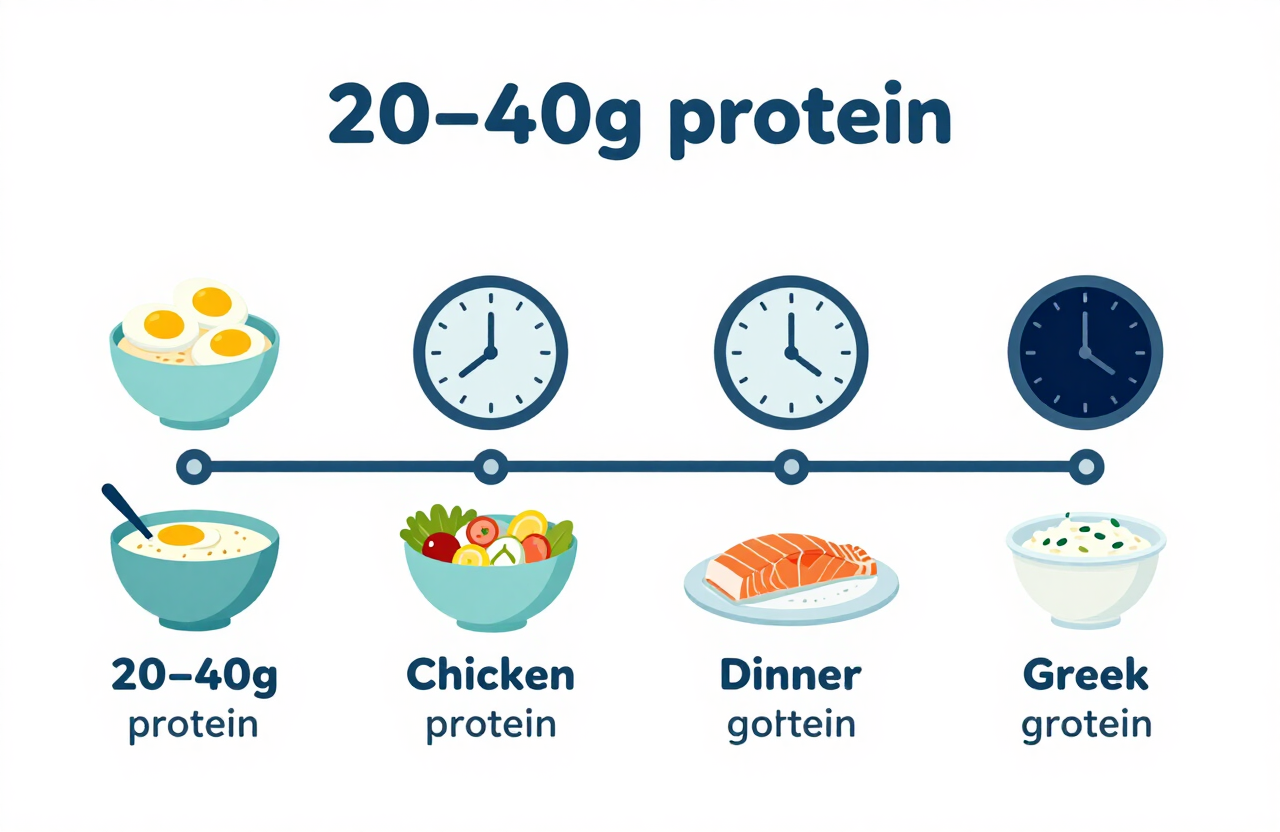
Your total daily intake matters most, but how you spread it across the day makes a difference too. Research suggests that distributing protein fairly evenly — roughly 20 to 40 grams per meal across three to four meals — maximizes muscle protein synthesis better than eating most of it in one sitting.
A practical pattern for someone targeting 140 grams per day might be: 35 g at breakfast, 35 g at lunch, 40 g at dinner, and 30 g from a snack or post-workout shake. You do not need to be exact — just avoid the common trap of a low-protein breakfast and a huge protein dinner.
What Are the Best High-Protein Foods?
The best protein sources are ones you enjoy, can afford, and will eat regularly. They generally fall into two camps — animal-based and plant-based — and both can support your daily target.
Animal-Based Protein Sources
- Chicken and turkey breast — lean, versatile, and about 31 g of protein per 100 g.
- Eggs — about 6 g each and a complete amino acid profile.
- Fish (salmon, tuna, cod) — roughly 20–25 g per 100 g, plus healthy fats.
- Greek yogurt — 15–20 g per cup, great for breakfast or snacks.
- Cottage cheese — about 11 g per 100 g.
- Lean beef and pork — 25–30 g per 100 g.
- Milk and whey protein — convenient, fast-absorbing options.
Plant-Based Protein Sources
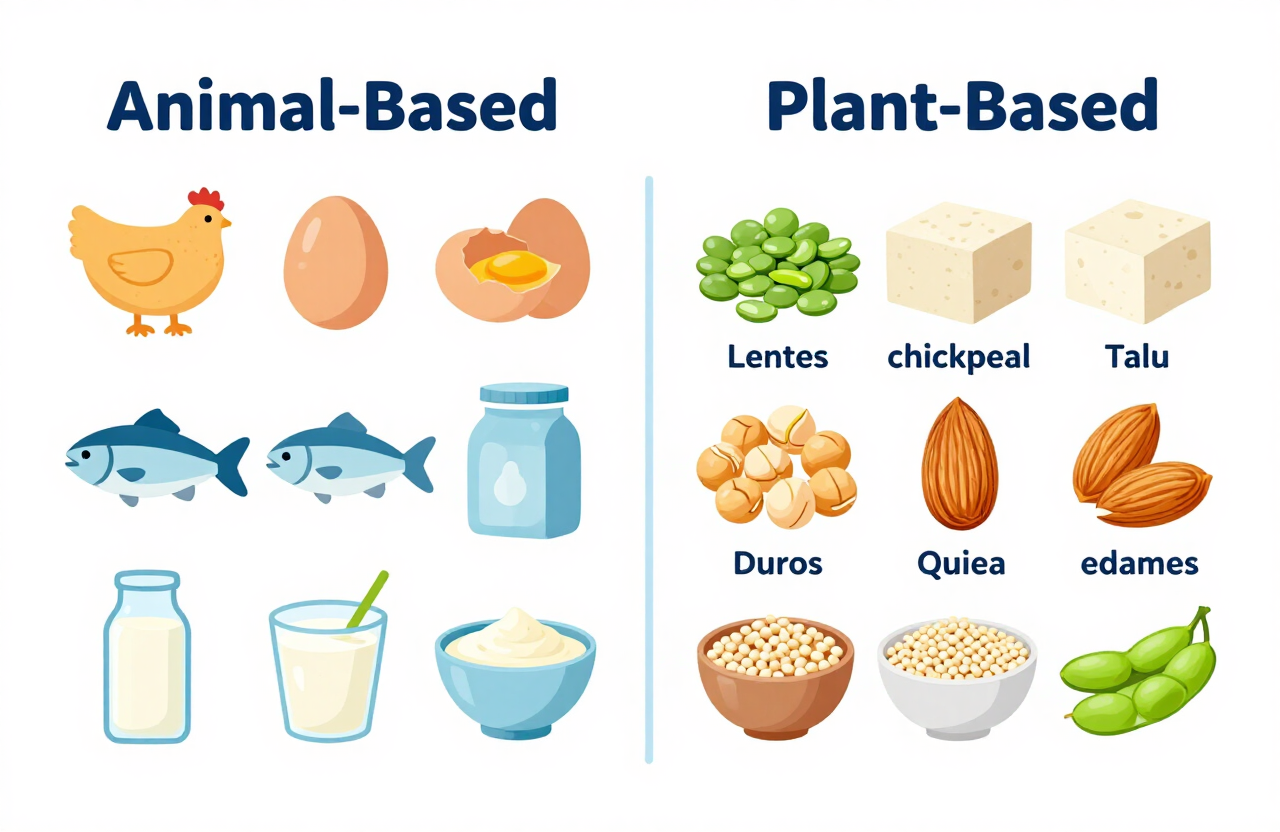
- Lentils — about 9 g per 100 g cooked, plus fibre.
- Chickpeas and most beans — 7–9 g per 100 g cooked.
- Tofu and tempeh — 12–19 g per 100 g, complete plant protein.
- Edamame — about 11 g per 100 g.
- Quinoa — 4–5 g per 100 g cooked, one of the few complete plant proteins.
- Nuts and seeds — almonds offer about 21 g per 100 g (but are calorie-dense).
- Pea and soy protein powders — convenient plant-based supplements.
Mix your sources
Most plant proteins are missing one or more essential amino acids, but eating a variety over the day (beans with rice, hummus with whole-grain pita) easily covers the full range. You do not need to combine them in every single meal.
How Much Protein Is in Common Foods?
To plan your day, it helps to know roughly how much protein is in the foods you eat. The table below lists common sources per typical serving.
| Food | Serving | Protein |
|---|---|---|
| Chicken breast (cooked) | 100 g | 31 g |
| Salmon (cooked) | 100 g | 22 g |
| Lean beef | 100 g | 26 g |
| Eggs | 1 large | 6 g |
| Greek yogurt | 1 cup (245 g) | 20 g |
| Cottage cheese | 1/2 cup | 14 g |
| Milk | 1 cup | 8 g |
| Lentils (cooked) | 1 cup | 18 g |
| Black beans (cooked) | 1 cup | 15 g |
| Tofu | 100 g | 12 g |
| Almonds | 28 g (~23) | 6 g |
| Quinoa (cooked) | 1 cup | 8 g |
| Whey protein powder | 1 scoop | 20–25 g |
Protein content of common foods per typical serving
Do You Need Protein Powder?
No — protein powder is a supplement, not a requirement. You can meet your daily protein target entirely with whole foods. That said, protein powder (whey, casein, or plant-based) is a convenient and cost-effective way to top up your intake, especially if you are busy, have a high target, or struggle to eat enough protein from meals alone.
A scoop of whey provides 20–25 grams of quality protein for relatively few calories and is absorbed quickly, which makes it popular post-workout. But a chicken breast, a bowl of Greek yogurt, or a cup of lentils does the same job. Use powder if it helps you hit your number; skip it if you do not.
Can You Eat Too Much Protein?
For healthy people, eating more protein than you need is generally not harmful — the body simply uses what it can and excretes the excess nitrogen. However, very high intakes (well above 2.5–3 g/kg) come with a few trade-offs:
- It can displace other foods — if half your plate is always protein, you may shortchange carbs needed for training energy or fats needed for hormones.
- Excess calories from protein can still lead to weight gain if they push you above your maintenance calories.
- Very high protein diets can cause digestive discomfort or constipation if fibre intake drops.
For most people, somewhere between 1.2 and 2.2 g/kg hits the sweet spot — enough to support your goals without crowding out the rest of a balanced diet.
Does Protein Damage Your Kidneys?
A common concern is that a high-protein diet harms the kidneys. The current evidence shows that high protein intake does not damage healthy kidneys. Your kidneys are well equipped to handle the extra work of filtering nitrogen waste from protein.
However, if you already have chronic kidney disease or reduced kidney function, a high-protein diet can accelerate damage, and you should follow your doctor's guidance on protein intake. If you are unsure about your kidney health — especially if you have diabetes or high blood pressure — get checked before significantly increasing your protein.
Is More Protein Better as You Get Older?
Yes — and this is one area where the standard RDA falls short. As you age, your body becomes less efficient at using protein to build muscle, a problem called anabolic resistance. At the same time, you naturally lose muscle mass (sarcopenia) from your 30s onward, which accelerates after 60.
Because of this, experts recommend older adults aim for 1.0 to 1.2 grams of protein per kilogram of body weight per day — higher than the 0.8 g/kg RDA — and spread it across meals. Pairing adequate protein with resistance training is the most effective way to preserve muscle, strength, and independence as you age.
Protein and Exercise
Exercise and protein work together. Training provides the stimulus — it tells your body which muscles to repair and grow — and protein provides the building blocks to do that work. Without enough protein, your body cannot fully respond to the training, no matter how hard you work out.
Your overall energy intake matters too. Your TDEE Calculator shows how many calories you burn each day, including exercise. Eating enough total calories means your body can use protein for building muscle rather than burning it for energy.
Should You Eat Protein Before or After a Workout?
You do not need to stress about an exact "anabolic window." What matters most is your total daily protein intake. That said, getting 20–40 grams of protein within a few hours before or after training is a sensible, evidence-based habit that gives your muscles the amino acids they need when they are most responsive.
If it suits your schedule, a protein-rich meal 1–2 hours before training and another within 1–2 hours after works well. If you train fasted or prefer to eat later, your daily total still does most of the heavy lifting. Consistency over weeks matters far more than timing to the minute.
How to Increase Your Protein Intake
If your current intake is low, you do not need to overhaul everything at once. Small swaps add up fast. Here are easy ways to add protein to each part of your day.
Breakfast
- Swap cereal for Greek yogurt with fruit and a handful of almonds (20+ g).
- Add two or three eggs or egg whites to your morning (12–18 g).
- Stir a scoop of protein powder into oatmeal or a smoothie (20+ g).
Lunch
- Add grilled chicken, tuna, or tofu to a salad or wrap (20–30 g).
- Use beans or lentils as a base for soups and bowls (15–18 g per cup).
- Choose cottage cheese or milk as a side (8–14 g).
Dinner
- Make a palm-sized portion of lean meat, fish, or poultry the centrepiece (25–35 g).
- Add edamame or roasted chickpeas as a side (8–11 g).
- Use quinoa instead of rice for a small protein boost (8 g per cup).
Snacks
- A scoop of protein powder in water or milk (20–25 g).
- A cup of Greek yogurt or cottage cheese (14–20 g).
- A handful of almonds or pumpkin seeds with jerky (10–15 g).
Protein Doesn't Have to Mean Meat
There is a persistent myth that you need meat at every meal to get enough protein. You do not. A well-planned plant-based diet can easily meet your daily target — lentils, beans, tofu, tempeh, edamame, quinoa, nuts, and seeds all contribute meaningful protein, and plant-based protein powders (pea, soy, rice) are effective supplements.
Even if you are not vegetarian, swapping in plant proteins a few times a week adds variety, fibre, and different micronutrients. The key is the same regardless of source: hit your total daily target with a mix of foods you enjoy.
Protein vs. Calories: Which Matters More?
Both matter, but they answer different questions. Calories determine whether your weight goes up, down, or stays the same — that is the energy balance equation. Protein determines more of what that weight change is made of: muscle versus fat.
If you want to lose fat while keeping muscle, you need both a calorie deficit (to lose weight) and enough protein (to preserve muscle). Eating lots of protein in a calorie surplus will still lead to fat gain. Think of calories as the steering wheel and protein as one of the most important components keeping the vehicle in good shape.
Use the Calorie Calculator to set your daily energy target, then use the Protein Calculator to set your protein within it. The Macro Calculator can balance the rest across carbs and fat.
Frequently Asked Questions
It depends on your weight, activity, and goal. The minimum is 0.8 g per kg of body weight (the RDA), but most active adults benefit from 1.2–2.2 g/kg. Use a protein calculator to find your specific target.
Aim for 1.6–2.2 grams of protein per kilogram of body weight per day, combined with consistent resistance training and a small calorie surplus. Going above 2.2 g/kg does not appear to build extra muscle for most people.
Roughly 1.2–1.6 g per kg of body weight per day helps preserve muscle while you lose fat. Higher intakes (up to 2.0 g/kg) can help if you are in a large deficit or already lean. Pair this with a moderate calorie deficit.
For healthy people, extra protein is generally not harmful — the body excretes the excess. But very high intakes can displace other nutrients, add unnecessary calories, or cause digestive issues. Most people do well between 1.2 and 2.2 g/kg.
No, high protein intake does not damage healthy kidneys. However, if you have existing kidney disease, a high-protein diet can be harmful. Check with your doctor if you have kidney concerns before increasing protein.
No. You can meet your target entirely with whole foods like chicken, eggs, fish, dairy, lentils, and tofu. Protein powder is simply a convenient supplement for busy days or high targets — useful, but not required.
Aim for roughly 20–40 grams per meal, spread across three to four meals. Distributing protein fairly evenly through the day supports muscle protein synthesis better than eating most of it at one meal.
Yes. Because of reduced protein efficiency and age-related muscle loss, older adults (65+) benefit from 1.0–1.2 g per kg per day, spread across meals, ideally paired with resistance training.
Plant proteins can fully meet your needs, though most are missing one or more essential amino acids. Eating a variety of plant proteins across the day easily covers the full amino acid range. Animal proteins are complete and slightly more anabolic per gram.
Total daily protein matters most. As a practical habit, get 20–40 g within a few hours before or after training. The exact timing is far less important than consistently hitting your daily target.
Calculate How Much Protein You Need
You now know how protein needs change with your weight, activity, and goal. The fastest way to turn that into a personal number is the Fitlydoo Protein Calculator — it does the math and gives you a daily target in seconds.
Free, no sign-up. Enter your weight, activity level, and goal to get your personalised daily protein target.
A Note About Protein Calculators
Informational, not medical advice
Fitlydoo calculators provide estimates for general wellness guidance only. They are not a substitute for professional medical advice, diagnosis, or treatment. Always consult a qualified healthcare provider or registered dietitian before making significant changes to your diet, especially if you have a health condition such as kidney disease.
Sources
- 1.National Institutes of Health, Office of Dietary Supplements. Nutrient Recommendations: Protein
- 2.National Academies of Sciences, Engineering, and Medicine. Dietary Reference Intakes for Energy, Carbohydrate, Fiber, Fat, Fatty Acids, Cholesterol, Protein, and Amino Acids
- 3.NIH Office of Dietary Supplements. Dietary Supplements for Exercise and Athletic Performance
- 4.National Center for Biotechnology Information (NCBI). Protein Intake of Adults
- 5.National Center for Biotechnology Information (NCBI). Evaluation of Dietary Protein and Amino Acid Requirements
Related Articles
Understanding Your BMR (Metabolism)
What is my BMR, and what does it really say about your metabolism? This plain-language guide explains Basal Metabolic Rate, how to calculate BMR, the crucial BMR vs TDEE difference, why your BMR might seem low, and how to raise it — with free calculators to find your own numbers.
Read article NutritionHow Many Calories Should You Eat Per Day?
Your daily calorie needs depend on your age, sex, size, activity, and goal. Here is a plain-language guide to figuring out exactly how many calories you should eat — and how to use that number.
Read article MetabolismUnderstanding Your BMR: The Science Behind Your Metabolism
Your Basal Metabolic Rate is the number of calories your body burns just to stay alive. This guide explains what BMR is, the Mifflin-St Jeor equation behind it, how it differs from TDEE, what affects it, and whether you can actually change your metabolism.
Read article