Understanding Your BMR (Metabolism)
What is my BMR, and what does it really say about your metabolism? This plain-language guide explains Basal Metabolic Rate, how to calculate BMR, the crucial BMR vs TDEE difference, why your BMR might seem low, and how to raise it — with free calculators to find your own numbers.
If you have ever blamed a "slow metabolism" for stubborn weight, you are in good company. It is one of the most repeated explanations in nutrition — and one of the most misunderstood. People talk about metabolism as though it were a single speed dial you are born with, either fast and forgiving or slow and punishing. The reality is far more interesting, and far more within your control.
At the center of that conversation is a number called your Basal Metabolic Rate, or BMR. It is the foundation of how your body uses energy, and once you understand it, almost every nutrition question — from how much to eat to why your weight loss stalled — becomes easier to reason about. This guide explains what BMR is, how to calculate it, how it differs from TDEE, and what to do if you have ever wondered, "why is my BMR so low?"
What Is My BMR? (The Hook & Definition)
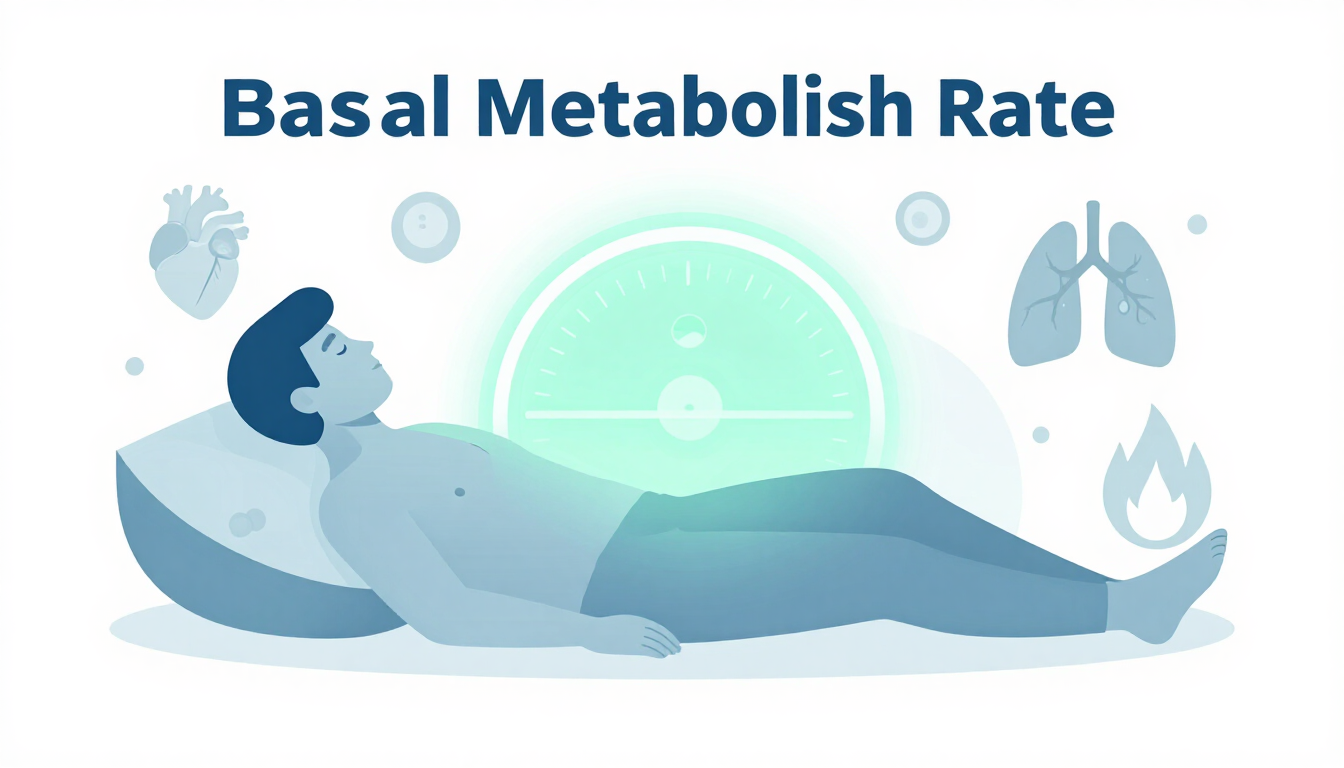
Your Basal Metabolic Rate (BMR) is the amount of energy — measured in calories — that your body burns just to stay alive. That means the calories used to keep your heart pumping, your lungs breathing, your brain firing, your kidneys filtering, and your cells repairing themselves. It is the energy you would expend if you lay in bed all day doing absolutely nothing, fully at rest, in a neutral-temperature room, after fasting.
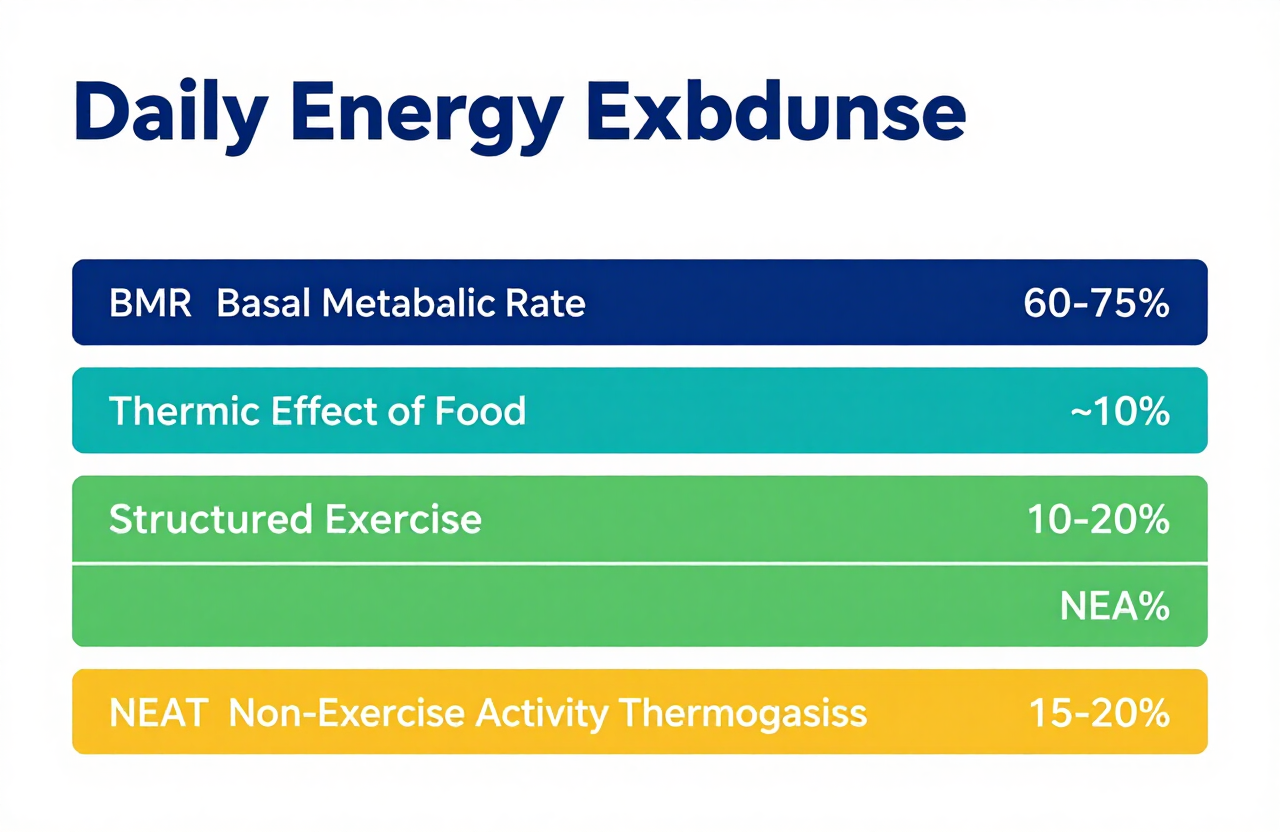
In other words, BMR is the cost of being alive. Even before you take a single step or digest a single meal, your body is spending energy to maintain itself. And here is the part that surprises most people: BMR is the single largest component of your daily calorie burn, typically accounting for roughly 60–75% of the energy you use each day. Movement, exercise, and digestion make up the rest.
So when someone asks, "what is my BMR?" they are really asking: how many calories does my body need at its absolute minimum, just to keep the lights on? That number is the floor of your energy needs — and it is the starting point for every calorie target you will ever set.
How to Calculate BMR: The Science
Because you cannot easily measure BMR directly outside a laboratory, scientists developed equations that estimate it from variables you already know: your age, sex, height, and weight. Two formulas dominate the fitness and medical world.
The Mifflin-St Jeor Equation
The Mifflin-St Jeor equation, published in 1990, is now the most widely recommended formula for the general population. Studies have repeatedly found it to be the most accurate predictor of resting energy expenditure for most adults, typically landing within about 10% of values measured by laboratory indirect calorimetry. It is the equation used by the Fitlydoo BMR Calculator and most modern nutrition tools.
The Harris-Benedict Equation
The older Harris-Benedict equation, originally developed in 1919 and revised in 1984, is still referenced in clinical settings. It uses the same inputs — age, sex, height, and weight — but tends to slightly overestimate BMR for many modern adults. Both equations are trusted because they were derived from large samples of real human energy expenditure data and have been validated against direct measurement in dozens of studies.
You do not need to memorise the math. What matters is understanding why these formulas are trusted: they are built on measured human data, they account for the four biggest drivers of resting energy (size, age, sex, and weight), and they have been stress-tested against gold-standard lab measurements for decades.
Want the deeper science?
For a reputable medical overview of how the body uses energy and what affects your metabolic rate, see the Mayo Clinic's guidance on metabolism and weight loss. (External reference linked in the Sources section below.)
Average BMR for Women and Men
It helps to have a baseline reference. While your exact BMR depends on your size and age, the average BMR for women typically falls between about 1,300 and 1,500 calories per day, while the average BMR for men usually sits between roughly 1,600 and 1,800 calories per day. The difference is driven mainly by body size and the fact that men, on average, carry more lean muscle mass, which burns more calories at rest.
| Group | Average BMR (kcal/day) |
|---|---|
| Adult women (average) | 1,300–1,500 |
| Adult men (average) | 1,600–1,800 |
| Larger or more muscular adults | 1,800–2,200+ |
| Smaller or older adults | 1,100–1,400 |
Typical BMR ranges for adults (estimated with Mifflin-St Jeor)
Remember, these are averages, not targets. A tall, muscular woman can easily have a BMR above 1,600, and a smaller, older man can sit below 1,500. Your own number is what counts.
Don't Want to Do the Math?
You do not have to. The fastest way to answer "what is my BMR?" is to let a calculator apply the Mifflin-St Jeor equation for you. Enter your age, sex, height, and weight, and you will have your baseline resting calorie burn in seconds.
Don't want to do the math? Use our BMR Calculator to find your baseline instantly — free, no sign-up.
BMR vs TDEE: The Crucial Difference
This is where many people go wrong. They calculate their BMR and then try to eat below it to lose weight — a mistake that can backfire by triggering muscle loss, fatigue, and a downward shift in metabolism. To use your numbers correctly, you have to understand the difference between BMR and TDEE.
BMR is just the starting baseline — the energy your body needs at complete rest. Total Daily Energy Expenditure (TDEE) is the number you actually burn in real life. TDEE takes your BMR and adds the calories you burn through daily movement, structured exercise, and the thermic effect of digesting your food.
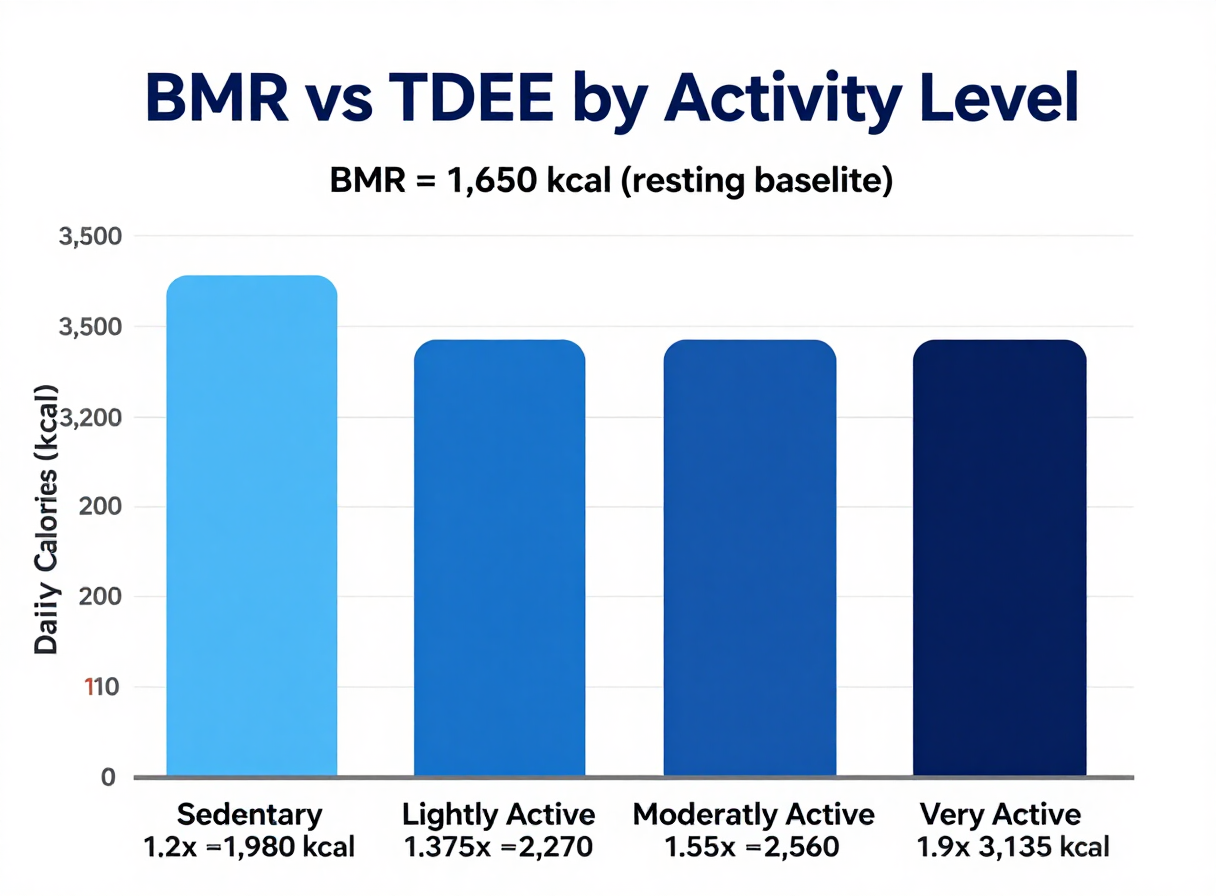
In short: BMR is the floor. TDEE is the real number you need to look at for weight loss, maintenance, or muscle gain. To lose weight you eat below your TDEE — not your BMR. To maintain, you eat at your TDEE. To gain, you eat above it.
The key relationship
Maintenance calories = TDEE. BMR is only the resting portion. Always set your calorie goals from TDEE, and never eat below your BMR for extended periods.
From BMR to Your Real Daily Burn
Once you know your BMR, the next step is to factor in your lifestyle. Your TDEE applies an activity multiplier to your BMR — ranging from about 1.2 for sedentary days up to 1.9 for very active ones — to reflect how much you actually move. That is the number that should anchor your nutrition plan.
Once you know your BMR, use our TDEE Calculator to figure out how many calories you actually burn with your daily exercise and lifestyle.
Why Is My BMR So Low? (Busting the "Slow Metabolism" Myth)
A lot of people look at their BMR result and think it seems low — and conclude they have a "slow metabolism" that dooms them to weight gain. In most cases, that is not what is happening.
True, clinically significant metabolic differences do exist, but they are rarer than the internet suggests. When people feel their BMR is low, the usual culprits are far more ordinary:
- Body size: A smaller body simply needs less energy to maintain. A lighter person will have a lower BMR by definition — that is normal, not broken.
- Muscle mass: Muscle is metabolically active and burns more calories at rest than fat. Less muscle means a lower BMR, regardless of body weight.
- Age: BMR declines by roughly 1–2% per decade after age 30, largely due to muscle loss and hormonal shifts.
- Sex: Women typically have a lower BMR than men of the same size because of a higher body-fat-to-muscle ratio.
- Crash dieting: Sustained very-low-calorie diets can suppress BMR through metabolic adaptation — your body slows down to conserve energy.
In other words, a "low" BMR is usually a reflection of size, muscle, age, and habits — not a broken metabolism. And critically, your BMR is not your destiny. The far bigger lever for weight management is your TDEE, which you can raise simply by moving more.
Don't eat below your BMR
Eating fewer calories than your BMR for extended periods risks muscle loss, nutrient deficiencies, hormonal disruption, and a further slowdown of your metabolism. Aim for a moderate deficit below your TDEE instead.
Can I Increase My BMR?
Yes — within limits, and not through the "metabolism-boosting" foods and supplements advertised online. The single most effective, evidence-based way to raise your BMR is to build and maintain lean muscle mass.
Here is why: muscle is metabolically active tissue. It burns calories around the clock just to exist, whereas fat tissue is relatively inert. Every kilogram of muscle you add raises your resting calorie burn by roughly 13 kcal/day. While that sounds modest per kilogram, building meaningful muscle through consistent resistance training can meaningfully raise your BMR over months and years — and it also increases the calories you burn during every workout.
Other habits that help protect or modestly support your BMR:
- Resistance training 2–4 times per week to build and preserve muscle.
- Eating enough protein (about 1.6–2.2 g per kg of body weight) to support muscle retention and growth.
- Avoiding crash diets — moderate deficits preserve metabolic rate better than aggressive restriction.
- Staying active generally — daily walking, standing, and movement keep your overall energy expenditure higher.
- Adequate sleep — poor sleep disrupts hormones that regulate appetite and energy balance.
To put this into practice, start by finding your baseline with the BMR Calculator, then map it to your real daily burn with the TDEE Calculator. From there, the Protein Calculator helps you set the protein target that protects and builds the muscle that keeps your metabolism running strong.
Frequently Asked Questions
Your BMR (Basal Metabolic Rate) is the number of calories your body burns at complete rest just to stay alive — breathing, circulating blood, and maintaining organ function. It typically accounts for 60–75% of your daily calorie burn. You can find your exact number with a BMR calculator that uses the Mifflin-St Jeor equation.
The most accurate method for the general population is the Mifflin-St Jeor equation, which uses your age, sex, height, and weight. The older Harris-Benedict equation is also used in some clinical settings. You do not need to do the math by hand — a BMR calculator applies the formula instantly.
BMR is the energy you burn at complete rest. TDEE (Total Daily Energy Expenditure) is BMR plus the calories you burn through daily movement, exercise, and digesting food. TDEE is the number you should use to set calorie goals for weight loss, maintenance, or muscle gain — not BMR.
A lower BMR is usually due to body size, lower muscle mass, age, or sex — not a broken metabolism. Smaller and less muscular people naturally need less energy at rest. Crash dieting can also suppress BMR. Building muscle through resistance training is the most effective way to raise it.
The average BMR for women is roughly 1,300–1,500 calories per day, while the average BMR for men is about 1,600–1,800 calories per day. Your individual number depends on your height, weight, age, and muscle mass, so use a calculator for a personal estimate.
Yes. Building lean muscle through consistent resistance training is the most effective way to raise your resting calorie burn, because muscle is metabolically active tissue. Eating enough protein, avoiding crash diets, and staying generally active also help support a healthy metabolic rate.
No. Eating below your BMR for extended periods can cause muscle loss, nutrient deficiencies, and metabolic slowdown. Instead, eat below your TDEE to create a moderate deficit of about 300–500 calories per day for sustainable fat loss.
Rarely. Most people who feel they have a "slow metabolism" are actually underestimating calorie intake, overestimating activity, or have a lower BMR due to smaller body size or less muscle. Tracking your TDEE and intake honestly usually reveals the real issue.
Put Your Numbers to Work
Understanding your BMR takes the mystery out of metabolism. It is not a fixed speed you are stuck with — it is a measurable baseline that shifts with your body, your muscle, and your habits. Find your BMR, turn it into your TDEE, and use those two numbers to set a calorie target that actually fits your life and your goal.
Free, no sign-up. Find your resting calorie burn in seconds, then move on to your TDEE.
A Note About Our Calculators
Informational, not medical advice
Fitlydoo calculators provide estimates for general wellness guidance only. They are not a substitute for professional medical advice, diagnosis, or treatment. Always consult a qualified healthcare provider before making significant changes to your diet or activity, especially if you have a health condition.
Sources & Further Reading
- 1.Mayo Clinic. Metabolism and weight loss: How you burn calories
- 2.American Journal of Clinical Nutrition. Mifflin MD, et al. A new predictive equation for resting energy expenditure in healthy individuals
- 3.Centers for Disease Control and Prevention (CDC). Healthy Weight, Nutrition, and Physical Activity
- 4.National Institute of Diabetes and Digestive and Kidney Diseases (NIDDK). Body Weight Planner
Related Articles
How Much Protein Do You Need Per Day?
Your daily protein needs depend on your weight, activity level, and goal — not a single universal number. Here is a plain-language guide to how much protein you really need per day, with examples, food tables, and a calculator to find your own target.
Read article NutritionHow Many Calories Should You Eat Per Day?
Your daily calorie needs depend on your age, sex, size, activity, and goal. Here is a plain-language guide to figuring out exactly how many calories you should eat — and how to use that number.
Read article MetabolismUnderstanding Your BMR: The Science Behind Your Metabolism
Your Basal Metabolic Rate is the number of calories your body burns just to stay alive. This guide explains what BMR is, the Mifflin-St Jeor equation behind it, how it differs from TDEE, what affects it, and whether you can actually change your metabolism.
Read article